

DigitalOcean Generative AI with Weaviate
Weaviate's integration with DigitalOcean's Serverless Inference allows you to access their generative models' capabilities directly from Weaviate.
Configure a Weaviate collection to use a generative AI model with DigitalOcean. Weaviate will perform retrieval augmented generation (RAG) using the specified model and your DigitalOcean API key.
More specifically, Weaviate will perform a search, retrieve the most relevant objects, and then pass them to the DigitalOcean generative model to generate outputs.
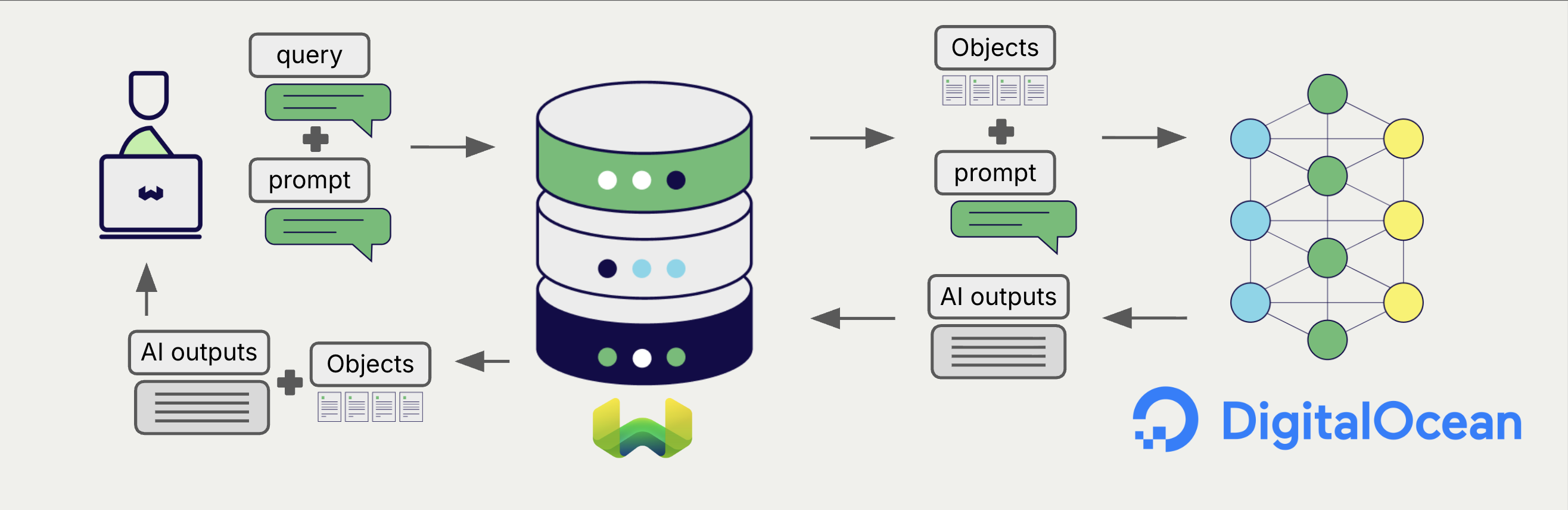
Examples for the other client languages will follow.
Requirements
Weaviate configuration
Your Weaviate instance must be configured with the DigitalOcean generative AI integration (generative-digitalocean) module.
v1.37.15, v1.38.13, and v1.39.2For Weaviate Cloud (WCD) users
This integration is enabled by default on Weaviate Cloud (WCD) instances.
For self-hosted users
- Check the cluster metadata to verify if the module is enabled.
- Follow the how-to configure modules guide to enable the module in Weaviate.
API credentials
You must provide a valid DigitalOcean API key to Weaviate for this integration. Generate one in the DigitalOcean Cloud console and supply it via one of:
- Set the
DIGITALOCEAN_APIKEYenvironment variable on the Weaviate server. - Provide the
X-Digitalocean-Api-Keyheader at request time, as shown below.
import weaviate
from weaviate.classes.init import Auth
import os

# Recommended: save sensitive data as environment variables
digitalocean_key = os.getenv("DIGITALOCEAN_APIKEY")
headers = {
    "X-Digitalocean-Api-Key": digitalocean_key,
}

client = weaviate.connect_to_weaviate_cloud(
    cluster_url=weaviate_url,                       # `weaviate_url`: your Weaviate URL
    auth_credentials=Auth.api_key(weaviate_key),      # `weaviate_key`: your Weaviate API key
    headers=headers
)

# Work with Weaviate

client.close()
Configure collection
A collection's generative model integration configuration is mutable from v1.25.23, v1.26.8 and v1.27.1. See this section for details on how to update the collection configuration.
Configure a Weaviate index as follows to use a DigitalOcean generative model:
from weaviate.classes.config import Configure

client.collections.create(
    "DemoCollection",
    generative_config=Configure.Generative.digitalocean(
        model="llama-4-maverick"
    )
    # Additional parameters not shown
)
Select a model
Set model to any model that DigitalOcean Serverless Inference serves for your account. See Available models for where to find the current names, and Generative parameters for the other settings you can configure alongside it.
You can also override the model at query time.
Generative parameters
Configure the following generative parameters to customize the model behavior.
from weaviate.classes.config import Configure

client.collections.create(
    "DemoCollection",
    generative_config=Configure.Generative.digitalocean(
        model="llama-4-maverick",
        # # These parameters are optional
        # temperature=0.7,
        # top_p=0.9,
        # max_tokens=500,
        # frequency_penalty=0.0,
        # presence_penalty=0.0,
        # stop=["\n\n"],
        # base_url="https://inference.do-ai.run",
    )
)
For further details on model parameters, see the DigitalOcean chat completions documentation.
Select a model at runtime
Aside from setting the default model provider when creating the collection, you can also override it at query time.
from weaviate.classes.generate import GenerativeConfig

collection = client.collections.use("DemoCollection")
response = collection.generate.near_text(
    query="A holiday film",
    limit=2,
    grouped_task="Write a tweet promoting these two movies",
    generative_provider=GenerativeConfig.digitalocean(
        model="llama-4-maverick",  # Any model your DigitalOcean account can serve
        # # These parameters are optional
        # temperature=0.7,
        # top_p=0.9,
        # max_tokens=500,
        # frequency_penalty=0.0,
        # presence_penalty=0.0,
        # stop=["\n\n"],
        # base_url="https://inference.do-ai.run",
    ),
    # Additional parameters not shown
)
Header parameters
You can provide the API key as well as some optional parameters at runtime through additional headers in the request. The following headers are available:
X-Digitalocean-Api-Key: The DigitalOcean API key.X-Digitalocean-Baseurl: The base URL to use (e.g. a proxy) instead of the default DigitalOcean URL.
X-Digitalocean-Api-Key takes precedence over the DIGITALOCEAN_APIKEY environment variable. The API key is never part of the collection configuration, so if neither the header nor the environment variable is set, the request fails with api key: no api key found.
X-Digitalocean-Baseurl takes precedence over a baseURL set at query time, which in turn takes precedence over the baseURL in the collection configuration. If none of them are set, Weaviate uses https://inference.do-ai.run. Provide an API root rather than a full endpoint path, because Weaviate appends /v1/chat/completions to it.
Provide the headers as shown in the API credentials examples above.
Retrieval augmented generation
After configuring the generative AI integration, perform RAG operations, either with the single prompt or grouped task method.
Single prompt
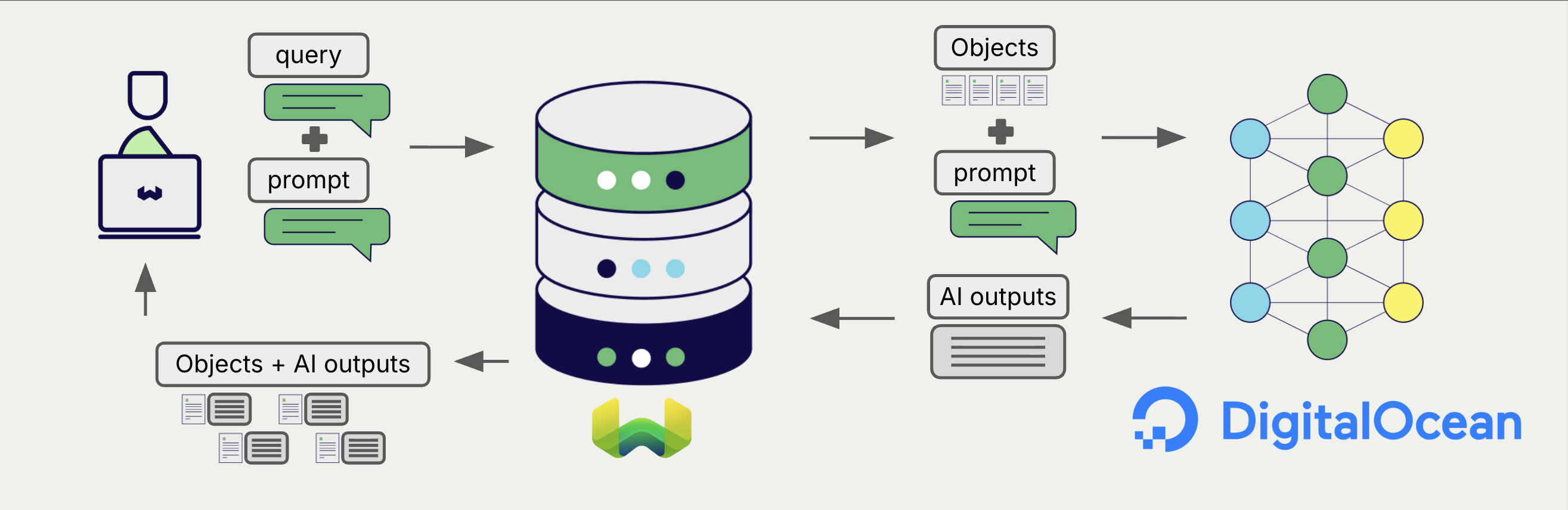
To generate text for each object in the search results, use the single prompt method.
The example below generates outputs for each of the n search results, where n is specified by the limit parameter.
When creating a single prompt query, use braces {} to interpolate the object properties you want Weaviate to pass on to the language model. For example, to pass on the object's title property, include {title} in the query.
collection = client.collections.use("DemoCollection")

response = collection.generate.near_text(
    query="A holiday film",  # The model provider integration will automatically vectorize the query
    single_prompt="Translate this into French: {title}",
    limit=2
)

for obj in response.objects:
    print(obj.properties["title"])
    print(f"Generated output: {obj.generated}")  # Note that the generated output is per object
Grouped task
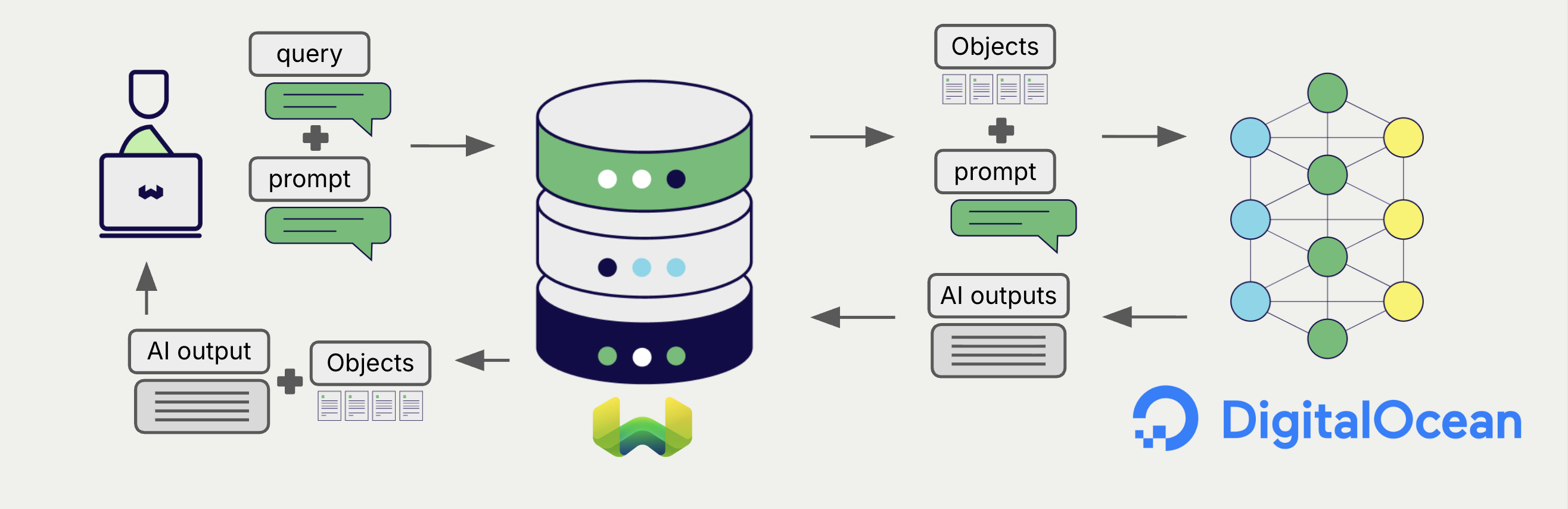
To generate one text for the entire set of search results, use the grouped task method.
In other words, when you have n search results, the generative model generates one output for the entire group.
collection = client.collections.use("DemoCollection")

response = collection.generate.near_text(
    query="A holiday film",  # The model provider integration will automatically vectorize the query
    grouped_task="Write a fun tweet to promote readers to check out these films.",
    limit=2
)

print(f"Generated output: {response.generative.text}")  # Note that the generated output is per query
for obj in response.objects:
    print(obj.properties["title"])
References
Available models
Weaviate forwards the configured model name to DigitalOcean as-is. The generative-digitalocean module keeps no list of model names and does not check the name, so a name that DigitalOcean does not serve is accepted when you create the collection and fails later, as an error from DigitalOcean at query time.
For the models available to your account, query GET /v1/models on the inference endpoint, or see the DigitalOcean Serverless Inference docs for the live list, as model availability can change.
Further resources
Other integrations
Code examples
Once the integration is configured at the collection, the data management and search operations in Weaviate work identically to any other collection. See the following model-agnostic examples:
- The How-to: Manage collections and How-to: Manage objects guides show how to perform data operations (i.e. create, read, update, delete collections and objects within them).
- The How-to: Query & Search guides show how to perform search operations (i.e. vector, keyword, hybrid) as well as retrieval augmented generation.
References
Questions and feedback
Have a question or feedback? Here's how to reach us.