

Multi-factor authentication
Multi-factor authentication (MFA) increases the security of browser logins. MFA is not enabled by default.
Enable multi-factor authentication
To enable MFA, follow these steps:
Open the Weaviate Cloud console.
- Click on the user menu in the top-right corner of the console.
Select
Account Settings.
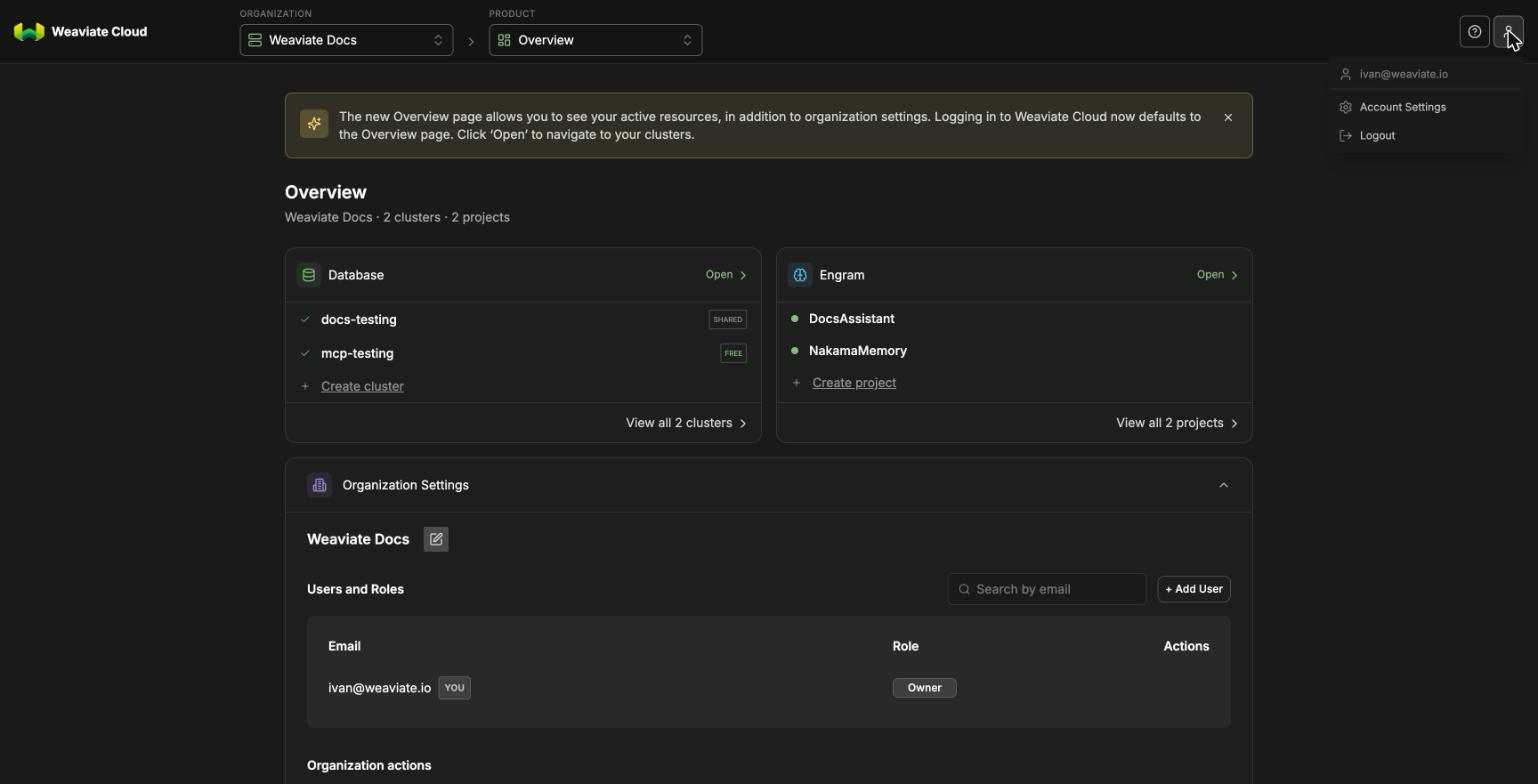
The user menu in the top-right corner holds
Account Settings.
In the
Multi-Factor Authenticationsection, clickEnable MFA.- Open your authenticator application and scan the QR code.
- Enter the one-time code from your application.
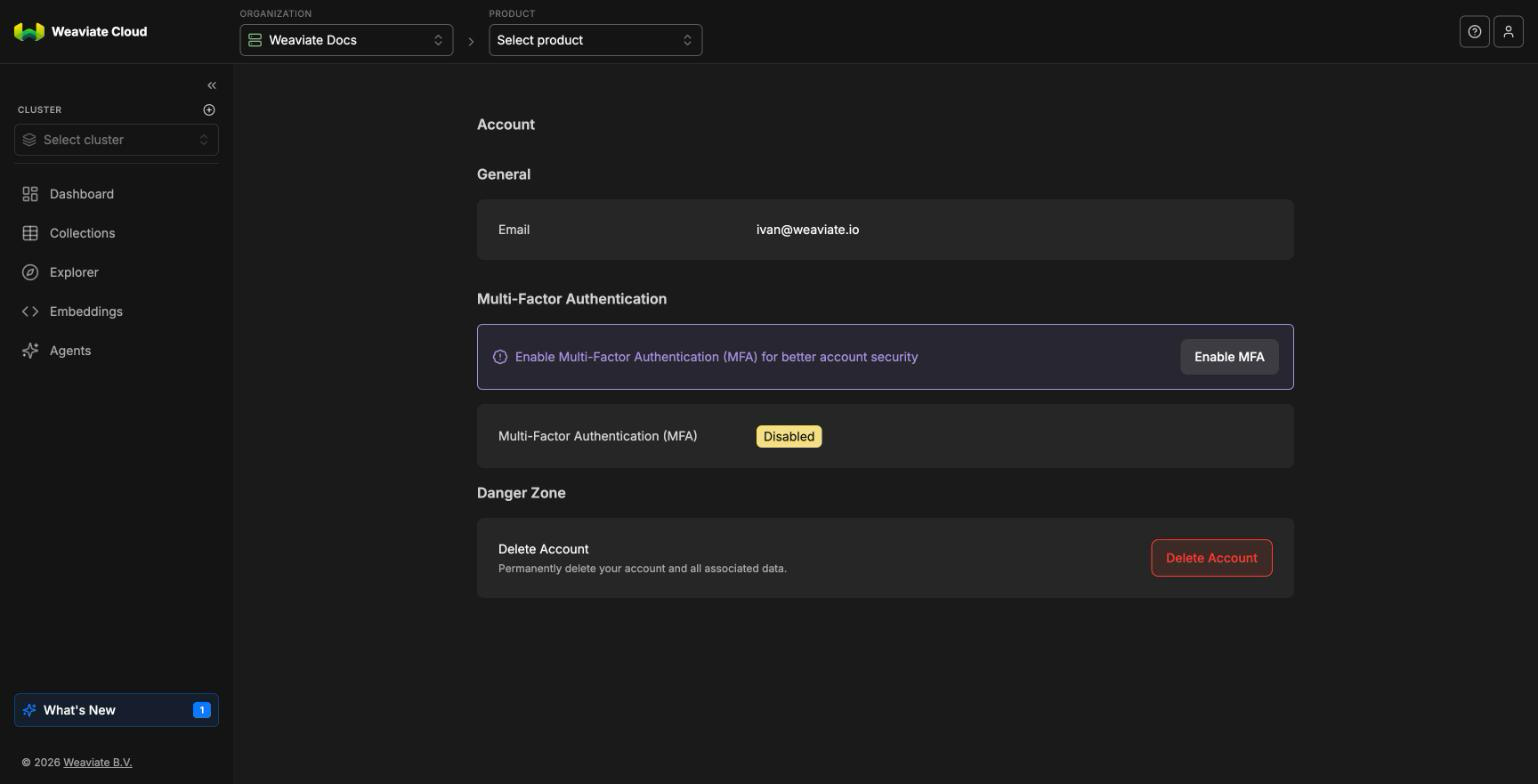
The Account page shows the Enable MFA button
and the current MFA status.
After you configure MFA, Weaviate Cloud prompts you to supply the one-time authentication code each time you log in.
Disable MFA
To disable MFA, contact support.
MFA and applications
If you use a JavaScript/TypeScript client to connect a browser hosted application to Weaviate, do not enable MFA for that client's account.
There is no way to pass the one-time authentication code to the application, so the application cannot connect to Weaviate Cloud.
Use API keys to connect browser based client applications to Weaviate Cloud.
Support
If you use Weaviate Cloud (Database cluster(s) or Weaviate product in the cloud) or have a self-hosted support package, open a ticket in the Support Portal or email Weaviate support directly. To add a support plan, contact Weaviate sales.
Use the Support Portal for direct help from the Weaviate team: open and track tickets, and we'll respond in line with your support plan. The Community Forum is open to everyone, and a great place to ask questions, get help with your cluster, and connect with other developers. For all the ways to get help, see the Support overview.